
IVF Series Laminar Flow Cabinets
- Provide an ISO Class 5 environment
- Used in human and animal reproduction
- Minimises microbial contamination in the aseptic handling of gametes and embryos
Clyde-Apac IVF Laminar Flow Cabinets provide an ISO Class 5 environment and can be custom-configured to suit the application. Fitted with an H14 HEPA Filter and AES Environmental’s advanced BSC control system the IVF range has been designed to be adaptable enough to suit any budget.
Applications
IVF/ART procedures for human and animal reproduction require a controlled work environment. Ultra-clean conditions are required to minimise microbial contamination in the aseptic handling of gametes and embryos. A warmed work surface is necessary to prevent thermal shock and, in most applications, provision for use of a microscope within the work zone is required. Clyde-Apac’s IVF Series laminar airflow cabinets satisfy these requirements.
Description
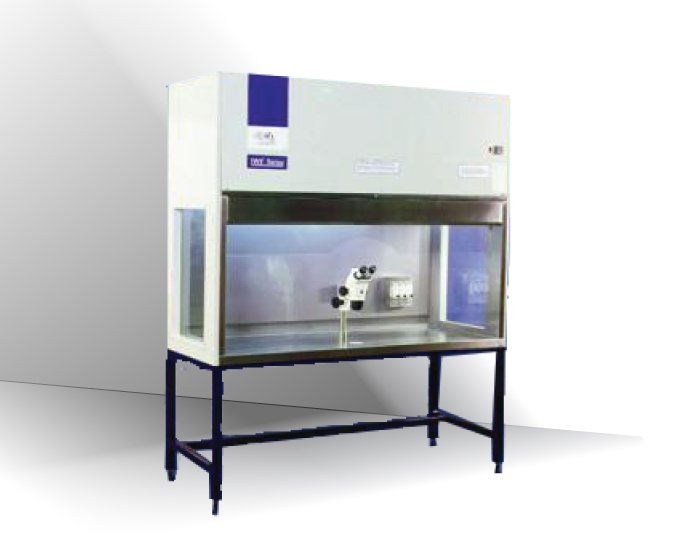
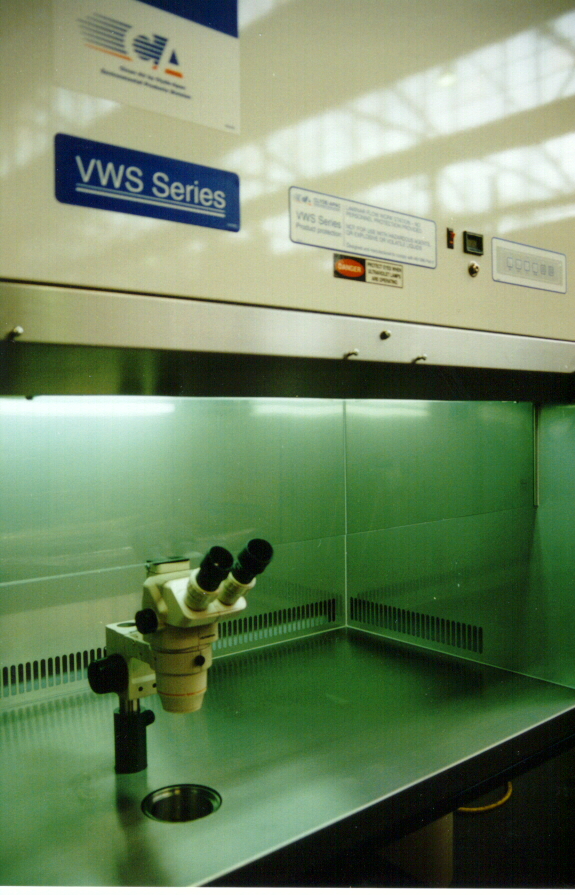
IVF Series cabinets are laminar flow workstations that are available with work zone width of 90cm, 120cm or 180cm. Internal work height of 80 cm allows effective and comfortable use of a wide range of stereo microscopes. The standard configuration supplied is a cabinet with a special floor stand, and this is the preferred arrangement. An optional configuration for installation on a normal laboratory bench is available, but this increases the internal work height to a point that may compromise ergonomics.
Heated panels under the stainless steel work surface maintain a temperature of 37.5OC with uniformity within 1OC. The entire work surface is heated except for the perimeter, with markings to delineate the heated area. A digital display mounted on the cabinet control panel indicates the temperature, and an audible alarm signifies any over-temperature condition. A penetration in the work surface and a window for transmitted light allow fitting of a specific stereo microscope that is provided by the cabinet user. The transmitted light source and transformer are located underneath the work surface*. Typically, the microscope penetration is located in the centre of the work zone with alternative locations on the left or right hand side. The user may provide a separate transparent heated stage over the light source.
Air cleanliness within the work zone is equivalent to ISO Class 5 (Class 100), ensuring a controlled environment suitable for sensitive applications such as IVF. Each cabinet is factory tested and certified to verify performance in line with recognised BS EN and ISO standards.
›› Heated work surface including electronic controller and digital display
›› Mounting frame for light source and transformer
›› Window for transmitted light
›› Stainless steel work zone
›› Partial airflow recirculation
›› Low voltage touch controls
›› Glare-free fluorescent lighting
›› Prefilter service indicator
›› Wheels fitted to floor stand
›› Bench-mount cabinet configuration (work height is increased)
›› Coloured fluorescent lighting, e.g. yellow
›› Separate power outlet for microscope light source
›› Gas flowmeters with regulating valve (specify number of meters required)
›› Incubator gassing hood, stainless steel
›› Warming blocks for follicular-fluid and culture tubes (with or without integral heating element)
›› Warming blocks for culture dishes
IVF Laminar Flow Cabinet Testing for UK Fertility Laboratories
In IVF and embryology laboratories, maintaining a controlled, contamination-free environment is critical to safeguarding embryo development and achieving successful outcomes. Our on-site testing service for IVF Laminar Flow Cabinets (LFCs) ensures that your equipment delivers the highest standards of cleanliness, reliability, and performance. Each service visit includes a full cabinet inspection, airflow velocity measurements to verify uniform protection across the work surface, and HEPA filter integrity testing using an aerosol challenge method to confirm no leakage of particles into the workspace. Smoke visualisation tests are also carried out to demonstrate smooth, laminar airflow and eliminate risks of turbulence that could compromise embryo culture. Additional checks on noise, vibration, and lighting support an optimal working environment for delicate IVF procedures. On completion, you receive a detailed compliance report aligned with UK health and safety expectations, helping your fertility lab meet regulatory requirements while providing confidence in the safety and consistency of your IVF processes.