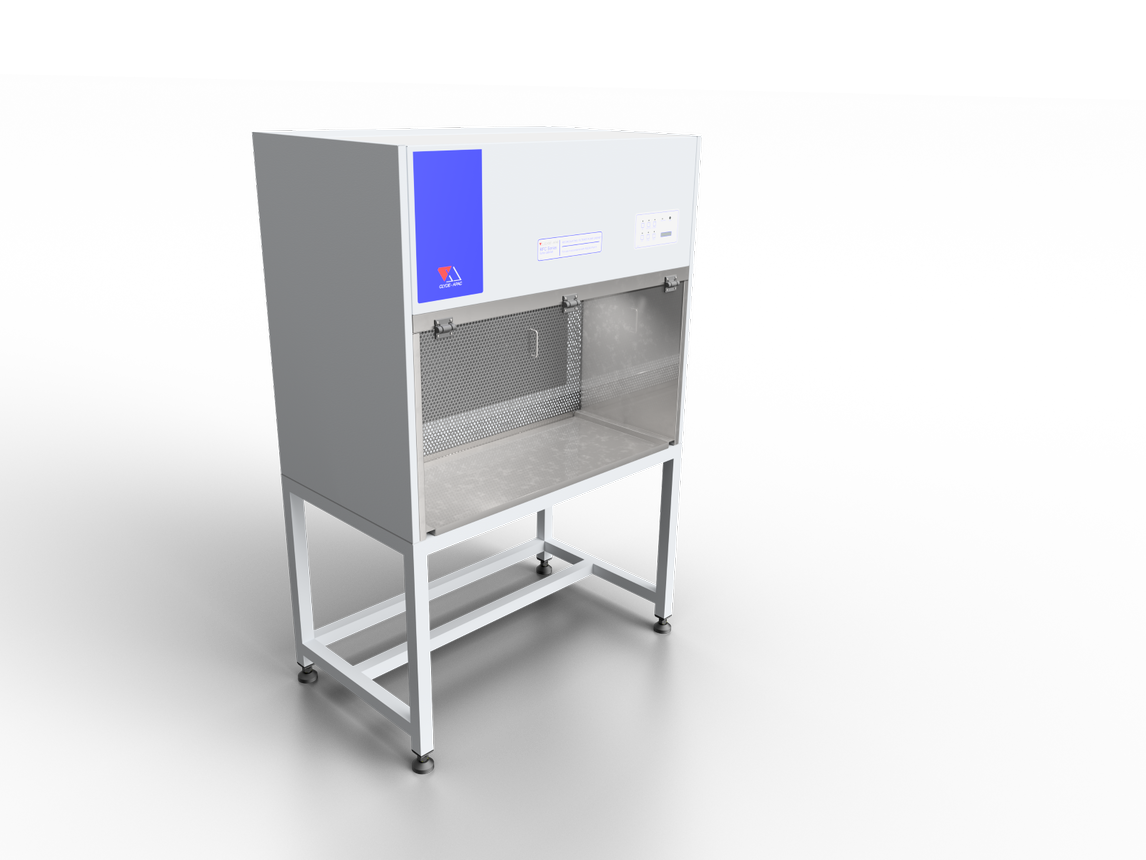
RFC Recirculating Fume Cabinet
- Suitable for benchtop use
- Supplied with a stainless-steel work tray
- Protects laboratory staff and the
environment from toxic vapours, gases, fumes
and particles
Description
The RFC Recirculating Fume Cabinet is suitable for benchtop use and supplied with a stainless-steel work tray. When supplied without the work tray, the cabinet may be installed over a sink or an item of equipment. RFC cabinets can be supplied with a special trolley or stand which allows a separate trolley to be wheeled into the containment enclosure. The mobility of trolley-mounted RFC cabinets is a significant advantage in hospitals or large research institutions, where materials such as glutaraldehyde are handled at multiple locations. These applications include endoscope sterilisation.
The RFC cabinet has an inward air velocity that is maintained at > 0.5 m/s ±20% for both benchtop and trolley-mounted installations. In most applications, filtered exhaust air may be discharged to the room. This avoids the air supply system problems that arise with ducted cabinets. In special cases, where the nature or concentration of the contaminant indicates, the cabinet exhaust may be connected to an exhaust fan/duct system that discharges to atmosphere.
RFC Recirculating cabinets are produced in two (2) sizes, with 900 or 1200 mm nominal work zone width. Custom sizes are available to order.
RFC cabinets are available with Activated Carbon Media, Alumina or a blend of media tuned to deal with the contaminants that will be produced during use. HEPA Filters can be added to the exhaust of the RFC to allow for capture of particulates.
The RFC Recirculating Fume Cabinet is produced in accordance with AS 2243.9 and can be validated by a NATA registered laboratory
Standard Features
- Low voltage touch controls
- Glare-free fluorescent lighting
- Comprehensive operation manual
- Quiet, low vibration operation
- Stainless steel work zone
- Floor stand
- Trolley Mounted
- Carbon filter for specific contaminants
- ‘Wheel-in’ configuration for endoscope trolleys
Recirculating Fume Cabinet Testing for UK Laboratories
Recirculating Fume Cabinets (RFCs) are widely used in laboratories where ducted extraction is not practical, relying on advanced filtration systems to remove hazardous fumes and vapours before recirculating clean air back into the workspace. Regular testing is essential to ensure these systems provide reliable operator protection and maintain compliance with UK safety standards. Our on-site testing service includes a visual inspection of cabinet integrity, airflow performance checks, and HEPA/activated carbon filter integrity testing using an aerosol challenge method to confirm filtration efficiency. Smoke visualisation tests are also carried out to demonstrate airflow patterns and confirm containment during operation. Supporting checks on noise, vibration, and lighting ensure safe and comfortable day-to-day use. On completion, a detailed compliance report is issued in line with COSHH obligations and HSE guidance, providing assurance that your recirculating fume cabinet continues to operate safely and effectively.
Cabinet
Outer casing of the RFC is constructed from galvanized steel, powder-coated to AS2700. The work zone is constructed in Grade 304 stainless steel. A removable aluminium screen is fitted in front of the prefilter at the rear of the work zone.
Fan
A direct drive motor/blower is regulated by a variable speed controller to enable airflows to be maintained through filter life.
Pre-Filters
A disposable polyester prefilter arrests no less than 90% of particulates > 5μm, thus prolonging carbon filter life. A warning light in the control panel signals the need for prefilter service.
Electrical
Cabinets operate on single-phase 240V, 50 Hz power via a 10A outlet. A low voltage touch control panel with function status indicated by LEDs is located on the front of the cabinet. Glare-free fluorescent lamps provide a minimum lighting intensity of 800 lux at the work surface.